Quickly master the basics of L2 layer network such as Ethernet, IEEE802.3 standard, Ethernet frame type, frame structure and MTU in one article
Original link: https://www.itylq.com/ieee8023-ethernet-frame-mtu.html
Release date: 2024-06-03 Migration time: 2026-03-21
1 The relationship between IEEE 802.3 working group, IEEE 802.3 standard and Ethernet
IEEE 802 is a committee of the International Institute of Electrical and Electronics Engineers (IEEE), called LMSC (LAN/MAN Standards Committee, Local Area Network/Metropolitan Area Network Standards Committee). The 802 committee is divided into multiple working groups, among which the 802.3 working group is responsible for defining the physical layer and data link layer of wired Ethernet.
Extension: Another well-known working group under the 802 committee is 802.11. IEEE 802.11 is responsible for formulating universal standards for wireless local area networks (WLAN). The well-known standards such as 802.11a, 802.11b, 802.11g, 802.11n, 802.11ac, 802.11ax (WiFi6) are all composed of 802.11 The working group is responsible for the formulation.
IEEE 802.3 standard was formulated and released by the IEEE 802.3 working group. It is a baseband bus-type LAN standard. It describes the implementation method of the MAC sublayer of the physical layer and data link layer.
Ethernet is a LAN that complies with the DIX Ethernet V2 standard. Because there is only a small difference between the DIX Ethernet V2 standard and the IEEE 802.3 standard, the 802.3 LAN is usually called Ethernet. Ethernet manages and controls data frames based on the IEEE 802.3 standard.
**Note: How to pronounce IEEE? **
I-E-E-E, of course there is no problem in reading it in alphabetical order, but the more professional and common reading is, I-[‘trɪp (ə)l]-E, which is the continuous pronunciation of I-Triple-E.
Triple [‘trɪp (ə)l] adj. Three parts; three; triple; three groups…
Ps. In competitive games such as League of Legends and CF, you can often hear the Triple-Kill sound, which represents "three kills".
2 Ethernet frame and frame format
The Ethernet frame is a data link layer protocol data unit (Protocol Data Unit, PDU) that complies with the Ethernet standard. It is the basic unit in the Internet protocol and is used to transmit data on the Ethernet.
There are two standard frame formats used in Ethernet, one is the DIX Ethernet V2 format, or Ethernet II, proposed in the early 1980s; the other is the IEEE 802.3 format proposed in 1983. The main difference between the two formats is that the Ethernet II format contains a Type field, which is used to identify which upper layer protocol the Ethernet frame will be sent to for processing after completion; while the IEEE 802.3 format has a Length field in the same position.
Different Type field values can be used to distinguish between two frame types:
- When the Type field value is ≤1500, the frame uses the IEEE 802.3 format (because the format field indicates the frame length, and the Ethernet frame MTU value is 1500);
- When the Type field value is ≥1536, the frame uses the Ethernet II format.
Most data frames in Ethernet use the Ethernet II format.
3 Ethernet frame structure
An Ethernet frame consists of three parts: Header, Data, and Tailer/Checksum.
The frame header occupies 14 Bytes, the tail occupies 4 Bytes, and the variable data length range is 46-1500 Bytes, so it can be seen that the Ethernet frame length range is 64-1518 Bytes.
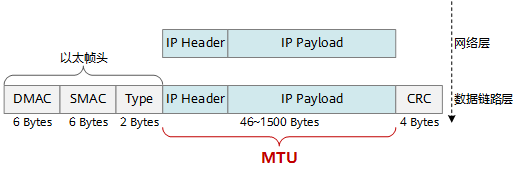
Field:
D.MAC: Target MAC address, occupies 6 Byte, commonly used 12 hexadecimal numbers plus 2/5 colons or midline symbols evenly separated, such as FF:FF:FF:FF:FF:FF, FF-FF-FF-FF-FF-FF, FFFF-FFFF-FFFF, FFFF:FFFF:FFFF;
S.MAC: Source MAC address, occupies 6 Byte;
Type: Type, occupies 2 Bytes, the representable value range is 0-4096, used to distinguish the frame encapsulation format (and identify the upper layer protocol, such as 0x0800, indicating that the upper layer protocol is IP; 0x86dd indicating that the upper layer protocol is IPv6; 0x0806 indicating that the upper layer protocol is ARP; 0x8847 indicating that the upper layer protocol is MPLS; 0x8864 indicating that the upper layer protocol is PPPoE);
FCS: Checksum checksum, which occupies 4 Bytes. If the check fails, the frame is considered to be incompletely transmitted or tampered with, and will be discarded directly.
4MTU
MTU (Maximum Transmission Unit), a concept of the data link layer, is used to limit the length of data frames at the data link layer. It refers to the maximum data packet size that the network can transmit, in bytes. The default MTU value for Ethernet frames is 1500.
Based on comprehensive considerations of network delay, transmission efficiency and other factors, networks with different link media types have different default MTU values. The following are the default values of some common networks:
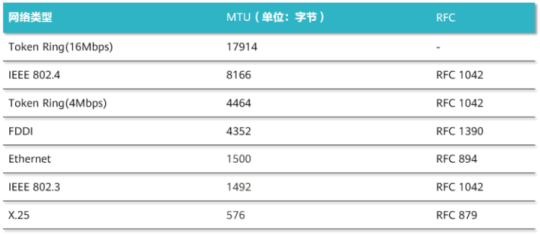
Generally speaking, the larger the default MTU value, the higher the transmission efficiency of this type of network (transmission efficiency = MTU/total length of data frame).
5 additional
**How will it be handled when the packet delivered by the upper layer is larger than the MTU? **
The data link layer will perform fragmentation processing. For the first piece of message, the IP message header is fixed at 20 Bytes, and the data payload is encapsulated at 1480 Bytes; for the second piece of message, the IP header of the first piece is copied, and the offset, flag bit, etc. are modified. The IP message is fixed at 20 Bytes, and the data payload is filled with the subsequent 1480 Bytes; the same is true for the third piece... until the Nth piece has split the message delivered by the upper layer.
This article was moved from WordPress to MkDocs